


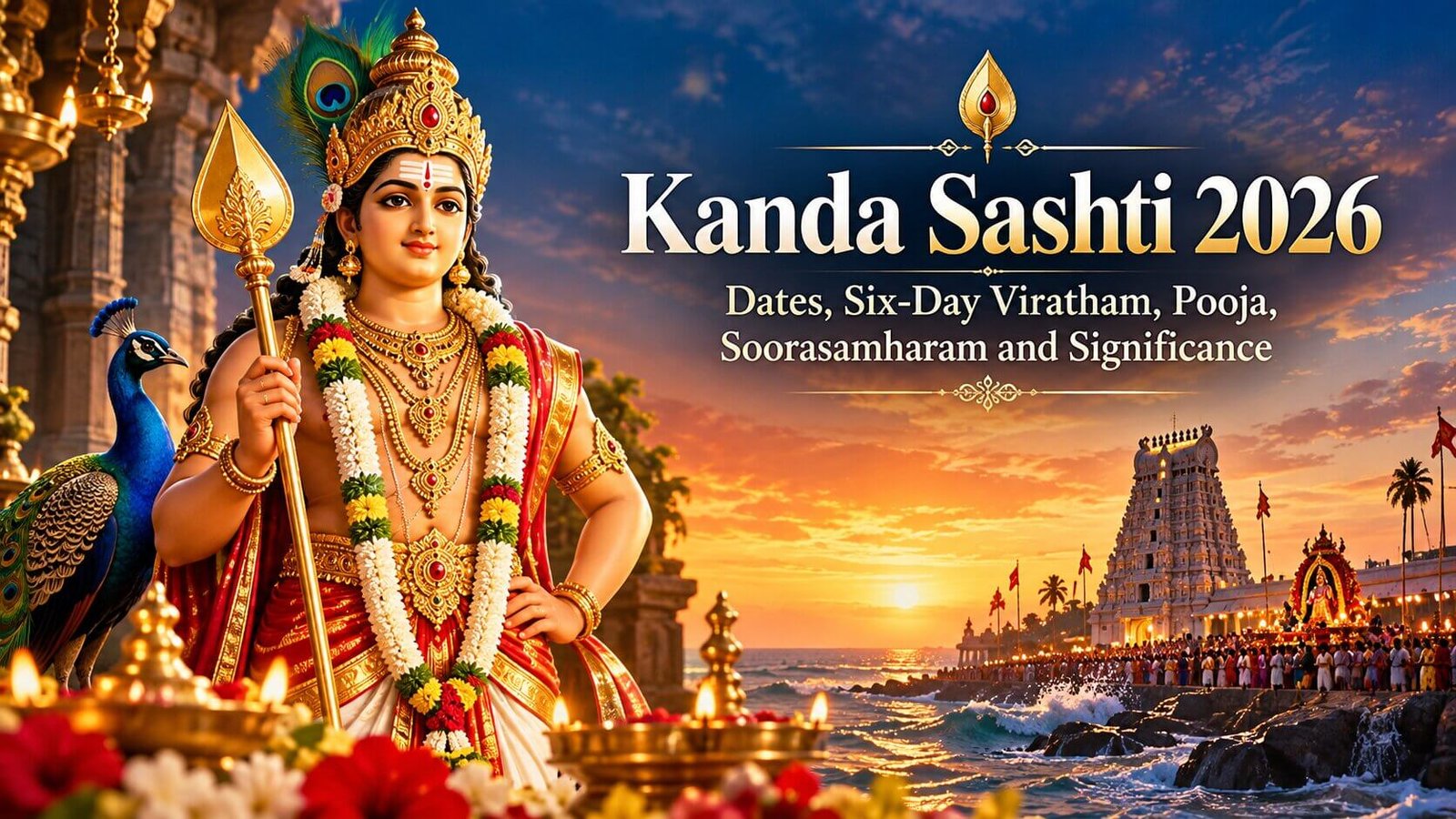
Kanda Sashti 2026 – Dates, Six-Day Viratham, Pooja, Soorasamharam and Significance
Kanda Sashti 2026 begins on Tuesday, November 10, 2026, and culminates with Soorasamharam on Sunday, November 15, 2026. The following day, November 16, is celebrated as Thirukalyanam, the divine wedding of Lord Murugan and Deivanai.
Kanda Sashti, also known as Skanda Sashti, Kandha Sashti or Kanda Shasti, is a sacred six-day festival that honours Lord Murugan’s victory over the asura Surapadman. It is one of the most important annual observances for Murugan devotees, particularly in Tamil Nadu and Tamil communities around the world.
For six days, devotees turn towards Lord Murugan through fasting (viratham), prayer, temple worship, devotional recitation and personal discipline. Some observe a strict fast. Others follow a simple vegetarian diet, chant Kanda Sashti Kavacham or pray before a Murugan idol or the sacred Vel. The festival is not merely about the defeat of an asura. It represents the victory of wisdom over ignorance, courage over fear and divine grace over arrogance.
Whether you are observing Kanda Sashti Viratham for the first time or continuing a family tradition, this guide explains the 2026 dates, the six-day observance, Soorasamharam, fasting customs, home pooja and the significance of Lord Murugan’s Vel.
Kanda Sashti 2026 – Important Dates and Timings
Kanda Sashti is traditionally observed during the waxing lunar fortnight following Deepavali, in the Tamil month of Aippasi. The festival begins on the first lunar day after Amavasya and continues for six days, culminating in Soorasamharam.
| Festival Day | Date | Observance |
|---|---|---|
| Day 1 | Tuesday, November 10 | Kanda Sashti Viratham begins |
| Day 2 | Wednesday, November 11 | Continued viratham and Murugan worship |
| Day 3 | Thursday, November 12 | Continued viratham and prayers |
| Day 4 | Friday, November 13 | Devotional observance |
| Day 5 | Saturday, November 14 | Preparation for Soorasamharam |
| Day 6 | Sunday, November 15 | Soorasamharam |
| Following day | Monday, November 16 | Thirukalyanam |
The dates correspond to the published 2026 Tiruchendur Kanda Sashti festival schedule and the Chennai festival calendar.
Kanda Sashti 2026 Shashti Tithi Timings
For Chennai, Tamil Nadu:
- Shashti Tithi begins: November 14, 2026, at 11:23 PM.
- Shashti Tithi ends: November 16, 2026, at 2:00 AM.
- Soorasamharam: Sunday, November 15, 2026.
These timings are based on the Drik Panchang calendar for Chennai. The exact timing of temple ceremonies, including Soorasamharam reenactments, must be confirmed with the respective temple, and devotees outside India should consult a panchangam calculated for their location rather than applying Chennai timings directly.
Why Does the Six-Day Fast Begin Before Shashti Tithi?
The word Shashti means sixth and refers to the sixth lunar tithi. However, the annual festival is a six-day observance that begins on Prathamai, the first day of the waxing lunar fortnight, and the sixth day marks Soorasamharam. Therefore, in 2026, devotees begin the viratham on November 10, even though the Shashti tithi itself begins late on November 14. This differs from the monthly Sashti viratham, which is observed on a particular lunar day.
What Is Kanda Sashti?
Kanda Sashti is a Hindu festival dedicated to Lord Murugan, the son of Lord Shiva and Goddess Parvati, who is also worshipped as Skanda, Kartikeya, Subramanya, Shanmukha, Kumara and Saravanabhava. He is revered as the divine warrior, the embodiment of wisdom and the protector of dharma. The festival commemorates his victory over Surapadman, whose actions threatened the devas and disturbed the cosmic order in the sacred narrative.
For devotees, it is an opportunity to seek Murugan’s blessings while cultivating discipline, humility, courage and spiritual awareness. The six-day observance traditionally includes fasting, temple visits, recitation of devotional hymns and prayers before Lord Murugan.
Meaning of Kanda Sashti
The name combines two words. Kanda is a Tamil name associated with Lord Murugan, corresponding to the Sanskrit name Skanda. Sashti refers to the sixth lunar day. Kanda Sashti therefore identifies the sacred Shashti observance dedicated to Lord Murugan.
The festival is also spelled Skanda Sashti, Kanda Shasti, Kandha Sashti and Kantha Sasti. These differences arise from the transliteration of Tamil and Sanskrit into English and do not represent separate festivals.
Why Is Kanda Sashti Celebrated?
Kanda Sashti celebrates Lord Murugan’s victory over Surapadman, as described in the Tamil Kanda Puranam tradition. According to the sacred narrative, Surapadman and the other asuras gained great power and oppressed the devas, who sought divine intervention. Lord Murugan emerged as the divine commander entrusted with restoring dharma. Armed with the sacred Vel bestowed by Goddess Parvati in the devotional tradition, he confronted the asuras and won victory over Surapadman. The sixth day commemorates this event through Soorasamharam.
The Story of Surapadman and the Mango Tree
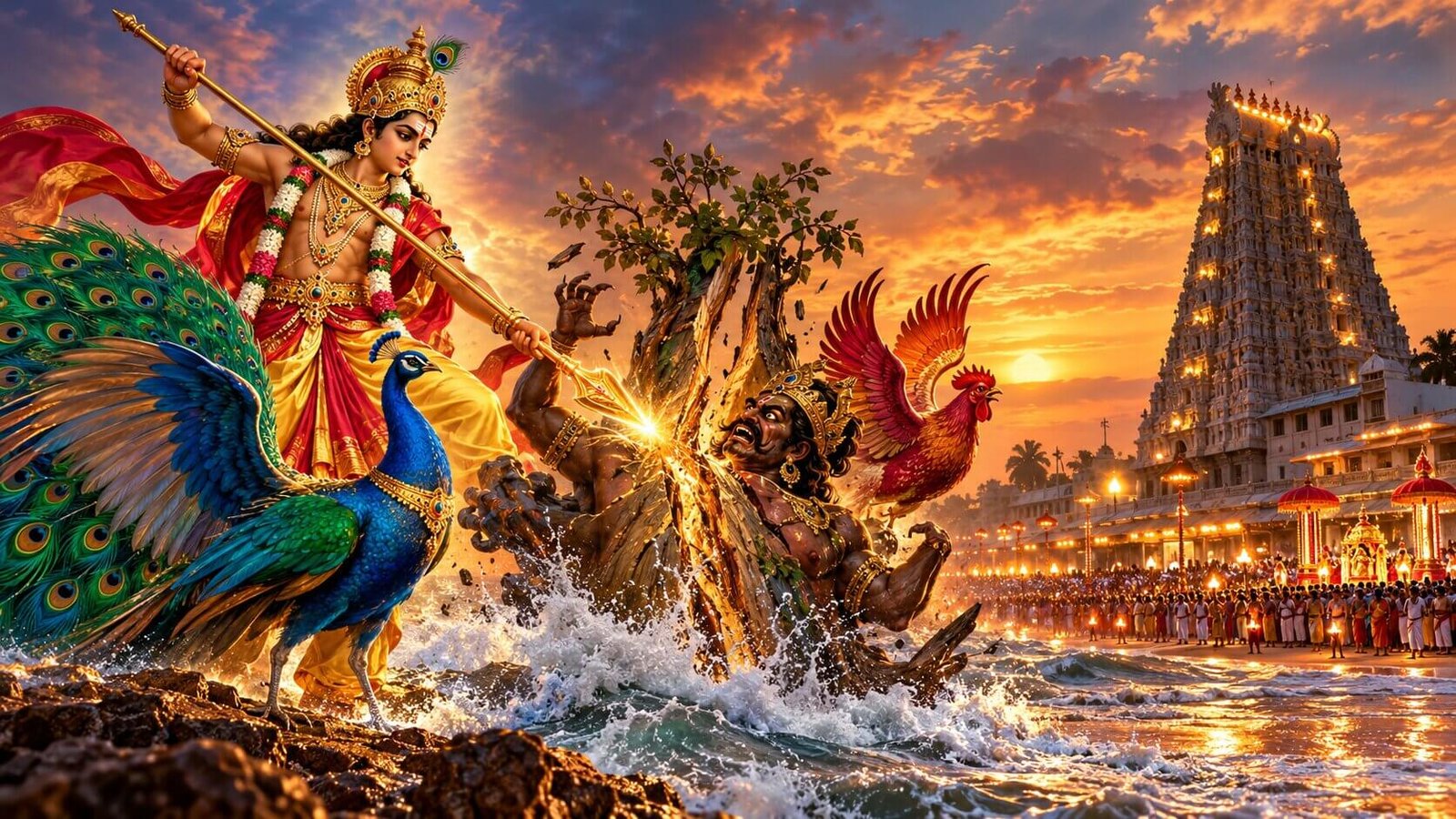
In the final stage of the battle, Surapadman assumed the form of a great mango tree associated with the ocean. Lord Murugan used his divine Vel to split the tree into two, and the two forms became a peacock and a rooster. The peacock became Murugan’s vahana, or divine vehicle, while the rooster became the emblem on his flag.
Surapadman is not remembered merely as an enemy who was destroyed. His transformation into symbols associated with Murugan is understood by many devotees as an expression of divine grace. The story suggests that even destructive qualities may be transformed when brought under divine wisdom.
Read the complete Soorasamharam story and Tiruchendur celebrations.
The Spiritual Meaning of Soorasamharam
Within devotional interpretation, Surapadman represents arrogance, ignorance, selfishness and attachment, while Lord Murugan represents wisdom, courage, discipline and the power of divine knowledge. These symbolic readings are devotional interpretations of the sacred narrative, rather than historical claims.
For devotees, the message is deeply personal. The difficulties we face are not always external. Fear, anger, pride, confusion and harmful habits can also become obstacles, and Kanda Sashti invites worshippers to reflect upon these inner struggles and seek the strength to overcome them.
The Six Days of Kanda Sashti – Daily Observance
The six-day viratham is a continuous period of devotion leading towards Soorasamharam. Temples follow established ceremonial schedules, while households follow their own customs. There is no single universally prescribed theme for each day. The following reflections are suggestions for home observance, not mandatory ritual assignments.
Day 1 – November 10: Beginning Kanda Sashti Viratham
The first day marks the commencement of the observance. Devotees traditionally bathe, wear clean clothes, prepare their prayer space and begin their chosen fasting practice. Some visit a Murugan temple to receive blessings before starting. At home, a devotee may light a lamp before Lord Murugan, offer flowers and begin with a simple prayer.
Take a clean yellow cotton thread and place it before Lord Murugan during your pooja. Pray for his blessings, protection and strength to complete the six-day fast. Generally, men and unmarried women may tie the thread (Kaapu) on their right wrist, while married women may tie it on their left wrist, unless their family or temple follows a different custom. You may ask a family elder or priest to tie it. Wear it throughout the six days and remove it respectfully after completing the concluding pooja.
A personal sankalpam, or devotional intention, may be made according to family tradition, for example a prayer for the strength to complete the observance with sincerity, patience and discipline. The first day is an opportunity to approach the festival with a calm and focused mind.
Day 2 – November 11: Continuing With Discipline
On the second day, devotees continue their fasting and prayer, with the emphasis on consistency. In Hindu devotional practice, fasting is not solely a restriction on food. It can also involve restraint in speech, behaviour and unnecessary distractions.
Devotees may spend time chanting Murugan’s names, reading devotional literature or listening to traditional hymns. A short period of sincere prayer can be meaningful even for those unable to perform an elaborate ritual.
Day 3 – November 12: Deepening Devotion
The third day marks the middle of the observance. Devotees may continue their chosen fasting practice while paying attention to their health and physical wellbeing. Kanda Sashti Kavacham is among the hymns commonly recited during this period.
Some families gather for evening prayers, offer flowers before Murugan’s image and chant familiar mantras. The day can also be used for personal reflection on patience, kindness and self-control.
Day 4 – November 13: Prayer and Inner Reflection
The fourth day continues the devotional journey. Devotees can reflect on how anger, pride and selfishness obstruct spiritual growth, and practise thoughtful speech, compassion and restraint. The purpose of the viratham is not simply to complete a number of fasting days, but to approach worship with greater awareness.
Day 5 – November 14: Preparing for Soorasamharam
The fifth day precedes the festival’s principal event, and preparations at Murugan temples intensify. Families observing the festival at home may clean their pooja space, arrange flowers and prepare the necessary worship materials. Devotees planning to visit a temple should confirm the festival schedule and make appropriate arrangements.
The evening may be spent in quiet prayer, chanting or reading the story of Lord Murugan.
Day 6 – November 15: Soorasamharam
The sixth day marks the culmination of Kanda Sashti, when Soorasamharam commemorates Murugan’s victory over Surapadman. At Tiruchendur, the event is reenacted as part of the temple’s major annual festival. In past years the reenactment has been held on the seashore in the evening, but timings vary.
On the sixth day, after Soorasamharam and completing your concluding pooja, gently untie the Kaapu and offer a prayer of gratitude to Lord Murugan. You may respectfully place the thread under a plant, immerse in flowing water or bury it in clean soil. If your family follows the seventh-day Thirukalyanam tradition, you may remove the Kaapu after completing that pooja instead.
Those observing Kanda Sashti at home may perform special worship, light a lamp, recite Kanda Sashti Kavacham and offer naivedyam.
After Soorasamharam prayers, many devotees break their fast with fresh banana stem (Vazhaithandu) juice mixed with curd or tender coconut water. Alternatively, a light salad can be prepared using finely chopped banana stem, pomegranate, apple, cucumber, soaked moong dal, and lemon juice.
Some families resume regular meals only on the 7th day, after Tirukkalyanam. Since the stomach has been on a light diet, choose simple, easily digestible Vazhaithandu dishes without onion, garlic, excess oil, or strong spices.
Kanda Sashti Viratham – How Is the Six-Day Fast Observed?
Kanda Sashti Viratham is a devotional vow involving fasting, prayer and personal discipline. The Tamil word viratham refers to a religious observance undertaken with a particular spiritual intention. Devotees follow different practices according to their health, circumstances and family traditions, and there is no requirement to follow the strictest form of fasting.
Common Kanda Sashti Fasting Practices
Simple vegetarian meals: Some devotees eat modest vegetarian food, in some households without onion and garlic, and avoid items restricted by their family tradition.
One meal a day: Certain households observe the viratham by taking one main meal daily.
Fruit and milk: Some devotees consume fruit, milk and other permitted light foods.
A shorter observance: Devotees unable to fast for six days may undertake a suitable observance on Soorasamharam day.
What Can You Eat During Kanda Sashti Viratham?
There is no single food list followed by all Murugan devotees, so choose a practice that suits your health and family custom. Prolonged fasting without adequate food or fluids can be dangerous. Pregnant or breastfeeding women, children, elderly people, those taking medication and people with medical conditions should not undertake restrictive fasting without appropriate medical advice. A devotional observance can include prayer and simple dietary discipline without compromising health.
For detailed fasting procedures, food restrictions and methods of concluding the observance, refer to the separate guide on Kanda Sashti Viratham.
How to Perform Kanda Sashti Pooja at Home
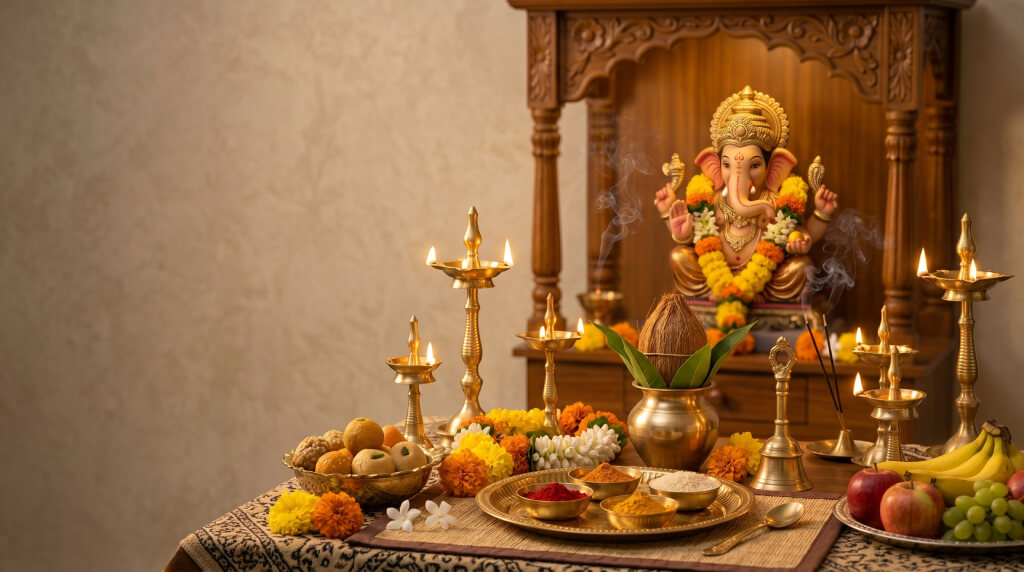
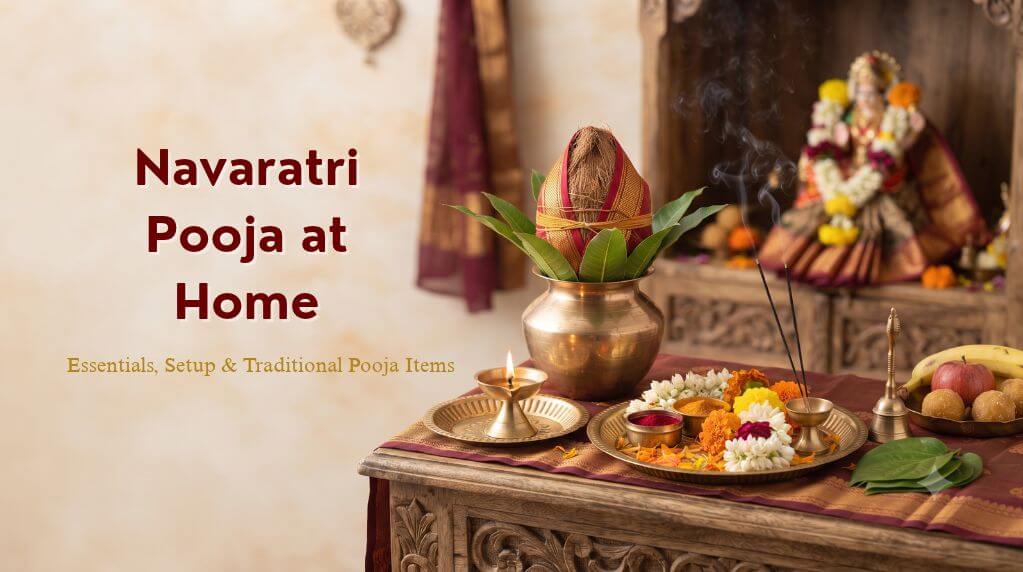
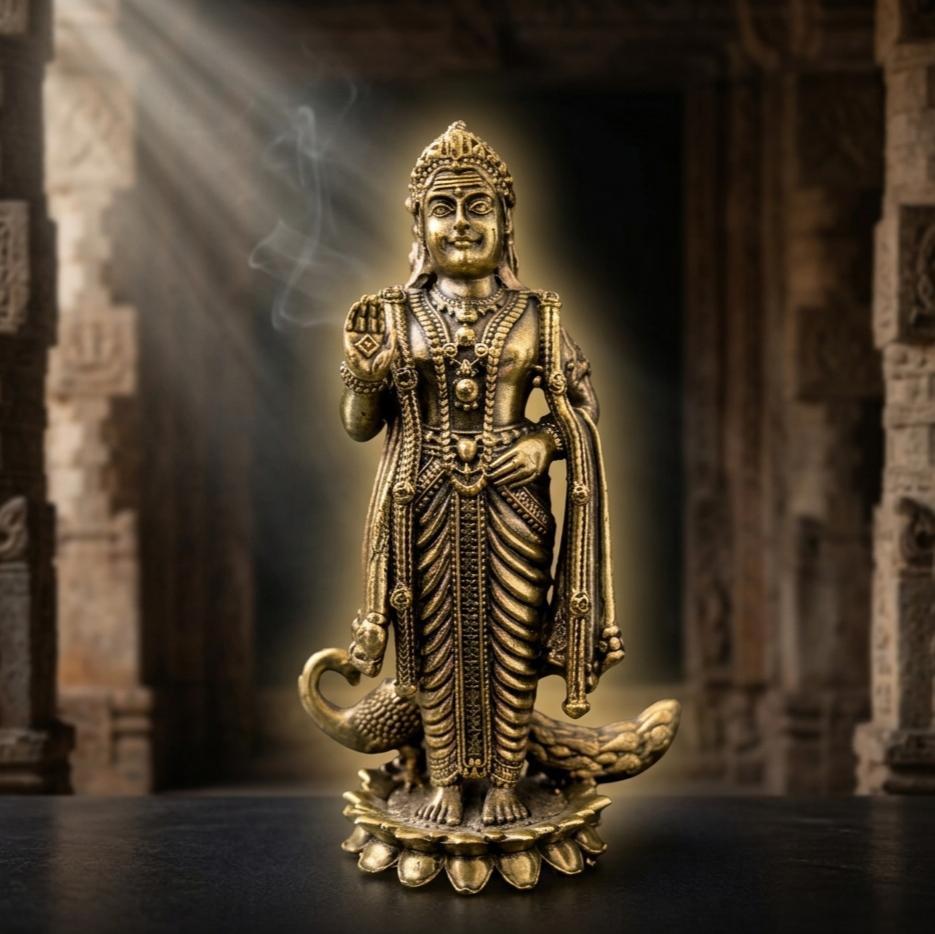
Kanda Sashti can be observed meaningfully at home, even without elaborate temple-style rituals. A clean prayer space, a Murugan image or idol, a brass lamp and sincere devotion are sufficient. Some families worship before a framed image of Lord Murugan, while others place a brass Murugan idol or a representation of the sacred Vel at the centre of their altar, according to family practice.
Preparing a Sacred Space for Lord Murugan
Many devotees prepare a special place for Lord Murugan in their home pooja room. A Brass Murugan Idol can serve as a traditional focal point for daily prayers and flower offerings, and may remain part of the family’s worship throughout the year. The Brass Vel is another meaningful representation, symbolising wisdom, courage and the power to overcome ignorance, and can be placed securely on the altar according to family custom. A simple arrangement with an idol or Vel, a brass lamp, fresh flowers and a small offering creates a peaceful setting for prayer.
Simple Kanda Sashti Home Pooja Procedure
The following is an accessible household worship sequence. It is not intended to replace the formal Agamic procedures followed in temples.
- Clean the prayer area and arrange the worship materials.
- Bathe or wash and wear clean clothes before beginning.
- Place Lord Murugan’s image, idol or Vel securely on the altar.
- Light a brass lamp safely, keeping it away from flammable materials.
- Begin with a prayer to Lord Ganesha if this is part of your family tradition.
- Offer flowers and apply or offer sandalwood paste and kumkum according to your worship custom.
- Chant a Murugan mantra or recite Kanda Sashti Kavacham.
- Offer fruit or another suitable vegetarian naivedyam.
- Perform a simple deeparadhana and conclude with prayers for the wellbeing of all.
The pooja may be performed in the morning or evening according to the household’s schedule. Devotees who follow a particular temple tradition or spiritual teacher should give precedence to those instructions.
Can Kanda Sashti Be Observed Without an Idol or Vel?
Yes. A devotee may pray before a picture of Lord Murugan or simply offer heartfelt prayers, and that devotion is complete in itself. Many families still give the six days a sacred centre, an idol or Vel on a clean altar with a lamp and fresh flowers, because traditional worship objects give devotion a visible focus. Their purpose is to support prayer, and they can help Kanda Sashti become a practice the home carries through the year.
The Significance of the Brass Vel During Kanda Sashti
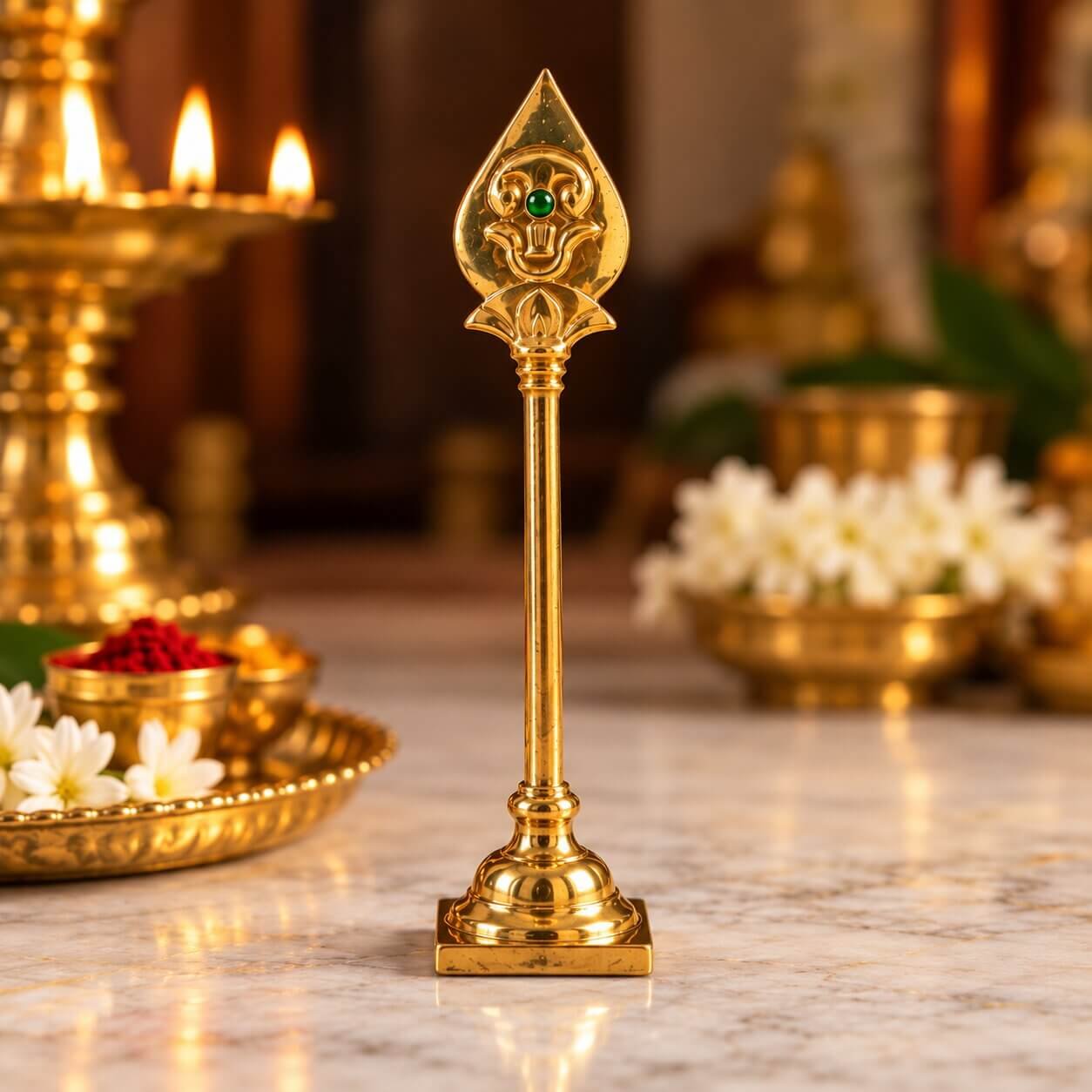
The Vel is among the most recognisable symbols of Lord Murugan. In the Kanda Puranam tradition, the divine spear is associated with the power bestowed upon Murugan for his battle against the asuras, and during Soorasamharam it becomes central to the final victory over Surapadman. Its symbolism extends beyond warfare. For devotees, the Vel represents knowledge that removes ignorance, courage that overcomes fear and spiritual clarity that helps distinguish right from wrong.
Why Do Devotees Worship the Vel?
In many Murugan worship traditions, the Vel is honoured as a sacred representation associated with the deity. Devotees may offer flowers, sandalwood paste, kumkum or other materials according to family custom, and some worship before a Vel even when no idol is present. A compact brass Vel suits a small home altar if it is placed stably and handled carefully. Because it is a reusable worship object, it can be part of daily Murugan prayers, monthly Sashti observances and the annual festival.
Kanda Sashti Pooja Items – What Do You Need?
A home pooja does not require an extensive collection of materials. The items used depend on family tradition, availability and the type of worship. Commonly used items include:
- Lord Murugan’s idol or framed image
- Brass Vel, where part of the family’s worship tradition
- Brass diya or traditional pooja lamp
- Kumkum and sandalwood paste
- Vibhuti, where customary
- Fresh flowers
- Incense
- Cotton wicks and suitable lamp oil or ghee
- Water for offerings
- Fruits or other vegetarian naivedyam
- A pooja thali for arranging worship materials
Not every item is mandatory. The purpose of these materials is to help create a respectful setting for prayer.
Kanda Sashti Kavacham – The Devotional Hymn of Protection
Kanda Sashti Kavacham, also written Kandha Sashti Kavasam or Skanda Shasti Kavacham, is one of the best-known Tamil hymns dedicated to Lord Murugan. Traditionally attributed to Devaraya Swamigal, it invokes Murugan’s protection and grace, and the Tamil word kavacham means armour. Many devotees recite it during the six-day festival, some every morning or evening and others by listening to a recitation. It may also be part of regular Murugan worship throughout the year.
Is Kanda Sashti Kavacham Compulsory During the Viratham?
No single devotional practice is universally compulsory for every household. Devotees unfamiliar with the hymn may begin with shorter prayers such as Om Saravanabhava, whose purpose, like all chanting, is to cultivate remembrance, concentration and faith. Devotional benefits should not be presented as guaranteed medical, financial or personal outcomes.
Recite the Kavacham from the printed text your family or temple follows, rather than from a screen copy of uncertain accuracy. Some families recite a portion each day and the full hymn on Soorasamharam. The Thiruppugazh hymns of Arunagirinathar and readings from the Kanda Puranam are also traditional companions to the six days.
Prayers and Shlokas for Kanda Sashti
Many households begin with a Ganesha invocation, then a Murugan dhyana shloka, a mantra and the Kavacham. The verses below are widely recited traditional prayers. Families and temples sometimes follow slightly different versions, so use the text of your own tradition where it differs.
Why Begin With Ganesha?
Hindu worship traditionally opens with a prayer to Lord Ganesha, known as Vighneshwara, the remover of obstacles, so that the rituals that follow proceed without hindrance. The custom applies to almost every pooja, and Ganesha is also Murugan’s elder brother, which makes the invocation especially natural before Kanda Sashti. It is a widely followed custom rather than a rule for this festival alone, and a single heartfelt line to Ganesha is enough.
Invocation to Lord Ganesha
Vakratunda Mahakaya
Suryakoti Samaprabha
Nirvighnam Kuru Me Deva
Sarvakaryeshu Sarvada
வக்ரதுண்ட மஹாகாய ஸூர்யகோடி ஸமப்ரப
நிர்விக்னம் குரு மே தேவ ஸர்வகார்யேஷு ஸர்வதா
Meaning: O Lord of the curved trunk and mighty form, radiant as a million suns, remove obstacles from all my undertakings, always.
Murugan Dhyana Shloka
Shadananam Kumkumarakta Varnam
Mahamatim Divya Mayura Vahanam
Rudrasya Sunum Surasainya Natham
Guham Sada Sharanam Aham Prapadye
ஷடாநநம் குங்குமரக்த வர்ணம் மஹாமதிம் திவ்ய மயூர வாஹநம்
ருத்ரஸ்ய ஸூநும் ஸுரஸைந்ய நாதம் குஹம் ஸதா சரணம் அஹம் ப்ரபத்யே
Meaning: I always take refuge in Guha, the six-faced Lord of crimson hue and great wisdom, who rides a divine peacock, son of Rudra and commander of the divine army.
Murugan Mantras
- Om Saravanabhava (ஓம் சரவணபவ) – the best-known Murugan mantra, easy to chant at any time of day.
- Om Shanmukhaya Namah (ஓம் ஷண்முகாய நம:) – salutations to the six-faced Lord.
- Om Subrahmanyaya Namah (ஓம் ஸுப்ரஹ்மண்யாய நம:) – salutations to Subrahmanya.
- Subrahmanya Gayatri: Om Tatpurushaya Vidmahe, Mahasenaya Dhimahi, Tanno Shanmukhah Prachodayat (ஓம் தத்புருஷாய வித்மஹே, மஹாஸேநாய தீமஹி, தந்நோ ஷண்முக: ப்ரசோதயாத்).
Many devotees chant a mantra 11, 21 or 108 times, but any count offered sincerely is enough.
Devotional Cries of Murugan Worship
Devotees traditionally close prayers and temple processions with the cries Vel Vel Muruga (வேல் வேல் முருகா), Vetri Vel Muruga (வெற்றி வேல் முருகா) and Arohara (அரோகரா). They are especially loud and joyful on Soorasamharam day.
A Simple Order of Prayer
- Ganesha invocation.
- Murugan dhyana shloka.
- Mantra chanting (Om Saravanabhava or the Subrahmanya Gayatri).
- Kanda Sashti Kavacham, or a portion of it.
- Deeparadhana, then close with Vel Vel Muruga! Vetri Vel Muruga!
Soorasamharam 2026 – The Victory of Lord Murugan
Soorasamharam is the central event of the festival. It commemorates Murugan’s victory over Surapadman and the restoration of dharma, and is especially associated with the Tiruchendur Subrahmanya Swamy Temple, situated beside the sea on India’s southeastern coast. The traditional battle narrative is represented through temple ceremonies and a public reenactment, and large numbers of devotees gather to witness it.
Why Is Tiruchendur Important During Kanda Sashti?
Tiruchendur is one of the six sacred abodes of Lord Murugan and is closely associated with his victory over Surapadman. Unlike several other major Murugan temples on hills, it stands beside the sea, and this coastal setting is important to the traditional account of the final confrontation. The annual Soorasamharam celebration here is therefore among the most significant expressions of Kanda Sashti devotion. Visitors should check the latest official temple announcements for ceremony timings, darshan arrangements and crowd-management instructions.
Can Soorasamharam Be Observed at Home?
Yes. Devotees unable to visit a temple can light a lamp, offer flowers, chant Murugan’s names, recite Kanda Sashti Kavacham or read the story of Surapadman, and families may explain the festival’s meaning to children. A home observance need not reproduce temple ceremonies. The central purpose is to remember Lord Murugan’s victory and reflect on its significance.
Thirukalyanam – The Day After Soorasamharam
Following Soorasamharam, many Murugan temples celebrate Thirukalyanam, the divine marriage of Lord Murugan and Deivanai. In 2026 it is observed on Monday, November 16, according to the Tiruchendur festival calendar.
The occasion introduces a different devotional mood. Soorasamharam commemorates victory and the restoration of dharma, while Thirukalyanam celebrates divine union, harmony and auspiciousness. In the traditional narrative, Deivanai, also known as Devasena, is given in marriage to Murugan following his victory over the asuras. The marriage is particularly associated with Tirupparankundram, although Thirukalyanam celebrations also form part of the festival at Tiruchendur.
Some devotees continue their observance through this day, while others conclude their fast following Soorasamharam. The appropriate practice depends on family and temple tradition.
Monthly Sashti vs Annual Kanda Sashti
Sashti tithi occurs twice during each lunar month, in the waxing fortnight (Shukla Paksha or Valarpirai) and the waning fortnight (Krishna Paksha or Theipirai). Many devotees observe monthly Sashti Viratham as part of regular Murugan worship. The annual Kanda Sashti festival following Deepavali is distinguished by its six-day observance and its association with Soorasamharam.
| Feature | Monthly Sashti | Annual Kanda Sashti |
|---|---|---|
| Frequency | Sashti tithi occurs twice monthly | Once a year as a major festival |
| Duration | Commonly a one-day observance | Traditionally six days |
| Focus | Regular Murugan worship | Victory over Surapadman |
| Main celebration | Sashti pooja | Soorasamharam |
| Worship setting | Home or temple | Home, temple and major festivals |
A devotee may observe monthly Sashti throughout the year and undertake the annual Kanda Sashti as a more extended devotional commitment. After Kanda Sashti, the next monthly Sashti falls in mid-December 2026. Check a panchangam for your location for the exact date.
The Spiritual Significance of Kanda Sashti Viratham
Kanda Sashti is traditionally associated with prayers for courage, protection, family wellbeing and the removal of obstacles. Some devotees also observe the viratham while praying for marriage, children or other personal aspirations. These are expressions of faith rather than guarantees of particular outcomes.
Discipline and Self-Control
The six-day observance encourages a consistent routine of prayer and restraint. Reducing unnecessary distractions, practising thoughtful speech and approaching others with kindness can form meaningful parts of the viratham.
Courage and Clarity
For devotees facing uncertainty or personal difficulties, the story of Soorasamharam offers an image of courage and perseverance, and the Vel stands for the power of wisdom to overcome ignorance.
Family Devotion
Kanda Sashti gives families an opportunity to pray together and share traditional stories. Children may learn about Lord Murugan, the Vel, the peacock and the meaning of Soorasamharam, and simple family prayers help preserve devotional traditions across generations.
Worship Beyond the Festival
The significance of Kanda Sashti does not end on the sixth day. A Murugan idol, Vel or traditional lamp used during the festival may continue to be part of daily prayers and monthly Sashti observances, so that the festival strengthens an ongoing relationship with worship rather than remaining an isolated annual event.
Common Mistakes to Avoid During Kanda Sashti
One common misunderstanding is confusing monthly Sashti with the annual six-day festival. Another is assuming that the six-day fast begins only when Shashti tithi starts. Some devotees also believe that everyone must follow the same food restrictions or fasting duration, but practices differ among households and temples, and severe fasting should never come at the expense of health.
Similarly, an elaborate pooja arrangement is not necessary for sincere devotion. A devotee may worship before a simple image of Lord Murugan and offer prayers according to personal circumstances. Finally, festival dates should always be checked against a reliable calendar for your location.
Frequently Asked Questions About Kanda Sashti 2026
1. When is Kanda Sashti in 2026?
Kanda Sashti begins on Tuesday, November 10, 2026, and culminates with Soorasamharam on Sunday, November 15, 2026.
2. When is Soorasamharam in 2026?
Soorasamharam is observed on Sunday, November 15, 2026. It commemorates Lord Murugan’s victory over Surapadman.
3. How many days is Kanda Sashti Viratham?
The annual Kanda Sashti Viratham is traditionally observed for six days, although devotees may follow shorter or less restrictive practices according to their circumstances.
4. What is the difference between Kanda Sashti and Skanda Sashti?
Both names refer to the same Murugan festival. The variation comes from Tamil and Sanskrit naming and English transliteration.
5. Can I observe Kanda Sashti without fasting?
Yes. Devotees may participate through prayer, temple worship, devotional recitation and suitable dietary practices without undertaking a restrictive fast.
6. What should I eat during Kanda Sashti Viratham?
Food customs vary. Some devotees eat simple vegetarian meals, while others consume fruit, milk or other permitted foods. Choose a practice appropriate to your health and family tradition.
7. Can I start Kanda Sashti Viratham on the sixth day?
A devotee unable to observe all six days may still offer prayers or undertake a suitable observance on Soorasamharam day. This is not the same as completing the traditional six-day viratham.
8. Can women observe Kanda Sashti during menstruation?
Practices vary among households and temples. Devotees may follow their family tradition and personal comfort, and nobody should feel compelled to undertake a restrictive fast. Those with questions about temple visits or specific rituals can consult their family elders or the temple.
9. Is a Brass Vel necessary for Kanda Sashti Pooja?
A Brass Vel is not mandatory, but it is the most fitting focal point for Kanda Sashti. The Vel is the weapon of Murugan’s victory at Soorasamharam, and many families place it at the centre of the altar for all six days.
10. Can I worship only the Vel without a Murugan idol?
Yes. In many Murugan traditions, the Vel is worshipped on its own as a sacred representation of Murugan’s power and grace, so no idol is needed beside it. Devotees offer flowers, sandalwood paste and kumkum to the Vel, light a lamp and recite Kanda Sashti Kavacham before it.
11. Which Murugan idol is suitable for home pooja?
A traditional Murugan idol appropriate to the household’s space and worship practice may be used. Brass idols are a popular choice because they are durable and suitable for long-term altar use.
12. What prayers are recited during Kanda Sashti?
Kanda Sashti Kavacham is among the most widely recited hymns. Devotees may also chant Murugan’s names or other familiar devotional prayers.
13. What is the significance of the Vel during Soorasamharam?
The Vel is the divine spear used by Murugan in the traditional narrative of his victory over Surapadman. It symbolises wisdom, courage and the removal of ignorance.
14. When should Kanda Sashti Viratham be completed?
Many devotees conclude their fast following the prayers associated with Soorasamharam. Others continue through Thirukalyanam, according to family or temple tradition.
15. What is celebrated after Soorasamharam?
Thirukalyanam, the divine marriage of Lord Murugan and Deivanai, is celebrated on the following day in many Murugan temple traditions.
Kanda Sashti – Six Days of Devotion, Courage and Grace
Kanda Sashti is more than the remembrance of a sacred battle. It is a six-day journey that brings together prayer, discipline, courage and faith. The story of Lord Murugan’s victory over Surapadman reminds devotees that wisdom can overcome ignorance and that divine grace can transform even the most difficult circumstances.
For some families, the festival means six days of fasting and temple worship. For others, it is a quieter observance marked by lighting a lamp, offering flowers or chanting a prayer before Lord Murugan. Whether you worship before an idol, the sacred Vel or a simple picture, let each ritual become a moment of gratitude and devotion.
Explore Pooja Essentials at Anugrah Aura
Vel Vel Muruga! Vetri Vel Muruga!
Related Guides
- Soorasamharam: Story and Tiruchendur celebrations
- Simple home pooja guide
- Daily pooja essentials
- How to do daily home pooja
References
- Drik Panchang – Soorasamharam 2026, Chennai – Festival dates, Shashti tithi and calendar rules.
- Tiruchendur Kanda Sasti 2026 Dates – Six-day festival schedule and Thirukalyanam.
- Tiruchendur Kanda Sashti Festival – Historical devotional commentary on the viratham and Soorasamharam traditions.