


Saraswati Pooja and Ayudha Pooja 2026: quick facts
Saraswati Pooja and Ayudha Pooja fall in the closing phase of Navaratri, but the exact sequence differs by region. In South India, books, musical instruments, tools, machines and vehicles may be cleaned and set aside for worship before being taken back into use on Vijayadashami. Kerala additionally has the familiar Pooja Veypu and Vidyarambham sequence.
For Kerala Pooja Veypu on 18 October, Saraswati and Ayudha Pooja on 20 October (Maha Navami), and Vijayadashami with Pooja Eduppu and Vidyarambham on 21 October. Dates vary by region and calendar, so check your local panchang.
Navaratri 2026 Dates by Region
The closing days of Navaratri 2026 are observed differently across India. Although the festivals fall between 18 and 21 October, the dates of Saraswati Pooja, Ayudha Pooja, Maha Navami, Vijayadashami and Vidyarambham depend on regional traditions, lunar tithi calculations and local panchang rules.
Navaratri Regional Festival Dates
| Region | Saraswati Pooja / Ayudha Pooja | Vijayadashami / Dussehra |
|---|---|---|
| Kerala | Pooja Veypu: 18 October; books and tools remain in worship through 20 October | 21 October – Pooja Eduppu and Vidyarambham |
| Tamil Nadu & Puducherry | 19–20 October, depending on local panchang and family tradition | 20 October in general panchang listings |
| Karnataka | 20 October – Ayudha Pooja | 21 October – Mysuru Dasara procession; some general calendars list 20 October |
| Andhra Pradesh & Telangana | Maha Navami and Ayudha Pooja observances around 19–20 October | 20 October in Drik Panchang listings |
| North India | Maha Navami observances around 19–20 October | 20 October – Dussehra and Ravan Dahan in major calendar listings |
Why Do Navaratri 2026 Dates Differ Across States?
Hindu festivals follow the lunar calendar, and their observance depends on the prevailing tithi (lunar day), sunrise calculations and regional religious customs.
In Kerala, Navaratri concludes with Pooja Eduppu and Vidyarambham, when children are traditionally initiated into learning. Books and tools are placed for worship during Pooja Veypu and taken back on Vijayadashami.
In Tamil Nadu, Saraswati Pooja and Ayudha Pooja are closely associated with the final days of Navaratri. Families worship books, musical instruments, tools and objects used in their daily work.
Karnataka’s Mysuru Dasara follows its own ceremonial calendar, with the grand Jamboo Savari procession scheduled for 21 October 2026.
In Andhra Pradesh, Telangana and much of North India, general Drik Panchang listings place Vijayadashami on 20 October 2026, although individual temples and communities may follow different observance rules.
Important: Festival dates can vary by location and sampradaya (religious tradition). Devotees should consult their local temple panchang before planning Saraswati Pooja, Ayudha Pooja, Vidyarambham or other time-sensitive rituals.
What is Saraswati Pooja?
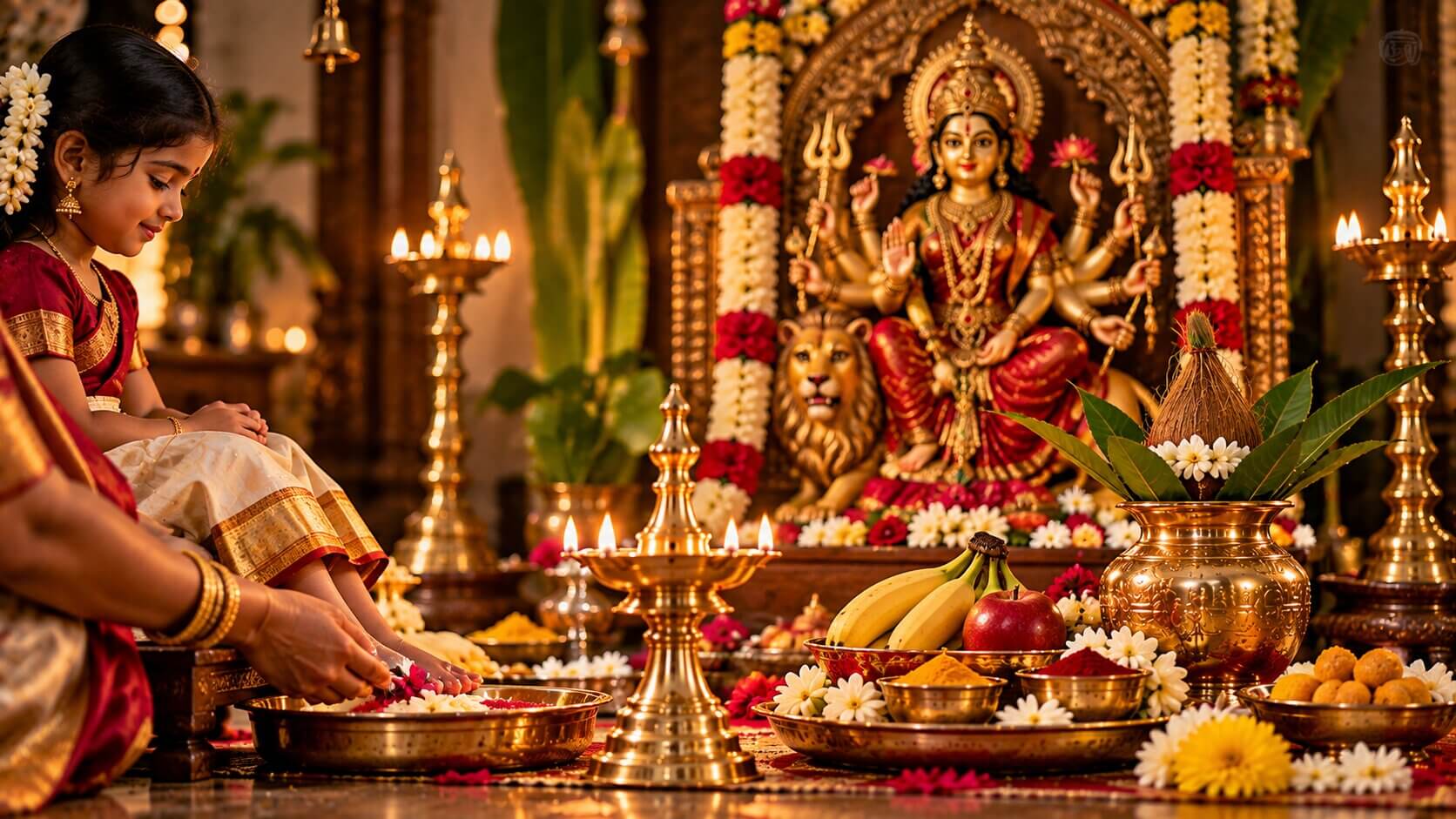
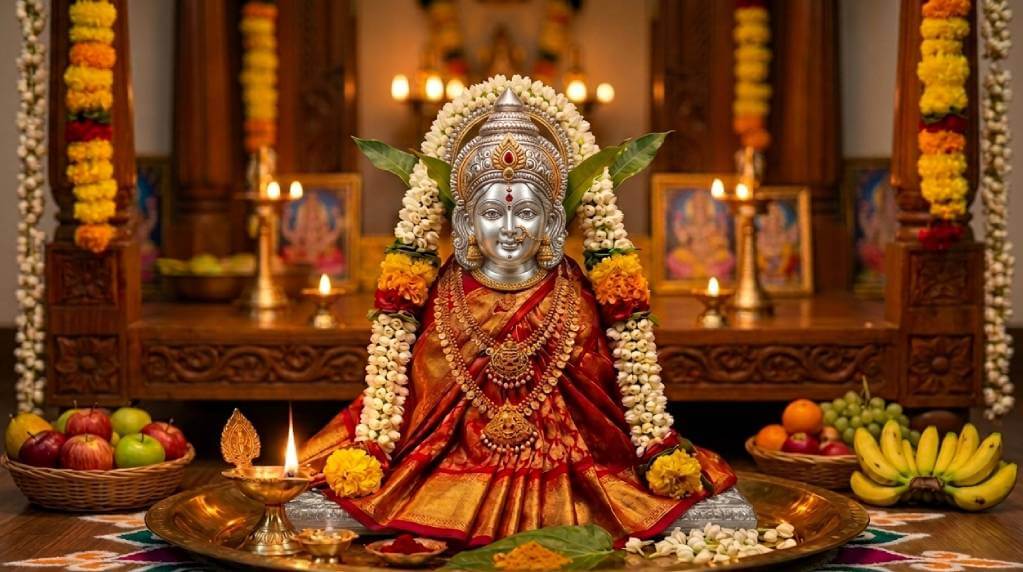
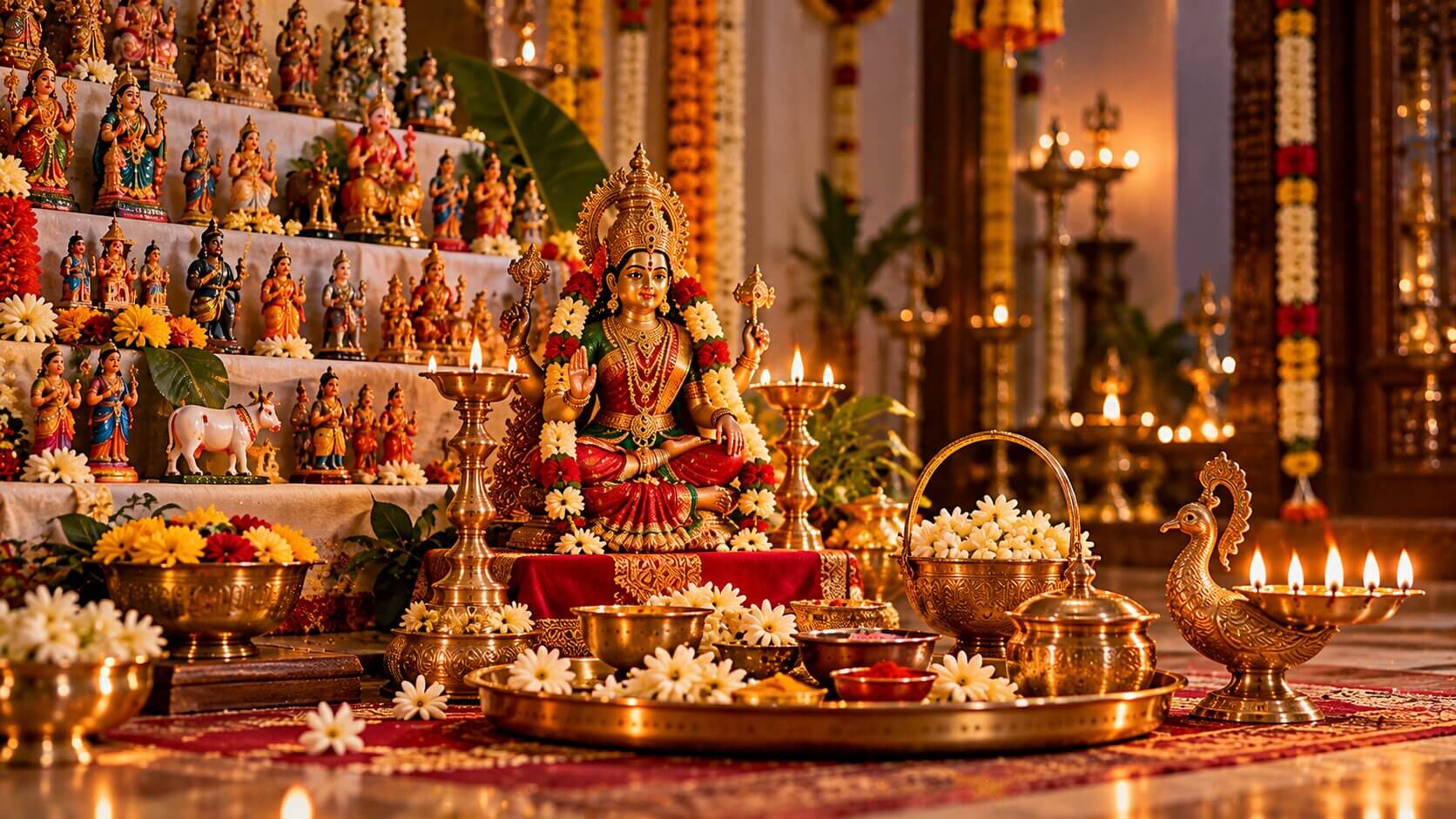
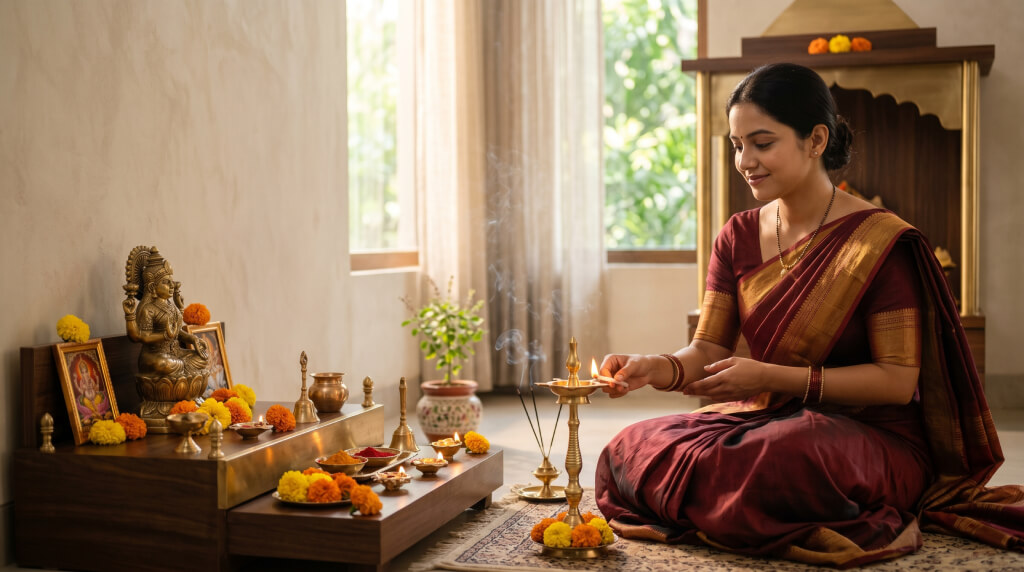
Saraswati Pooja honours the Goddess of knowledge, learning, music, speech and the arts. In many South-Indian homes, books and instruments are placed before the deity and intentionally left unused for the worship period.
The symbolism is unusually practical: the objects through which knowledge is acquired-books, notebooks, musical instruments and learning tools-are cleaned, arranged and temporarily set aside. The pause itself becomes part of the worship. Instead of treating learning only as effort or examination performance, the household acknowledges knowledge as something worthy of reverence.
For children, this can be explained without superstition: the books are not “magically blessed” by being left untouched. The custom creates a ritual pause before learning begins again, with renewed attention, on Vijayadashami or Vidyarambham.
What is Ayudha Pooja?
The Sanskrit word ayudha can mean an implement or weapon, but the modern South-Indian observance extends naturally to the tools of one’s occupation. A carpenter may honour tools, a musician an instrument, a driver a vehicle, a craftsperson equipment, and an office worker the devices genuinely used for work. The common thread is gratitude for the means through which skill becomes action.
Traditionally this included weapons and implements. Today it may include workshop tools, machinery, musical instruments, office equipment and vehicles.
What not to include
There is no need to place every appliance, phone or household object before the altar. Select the books, instruments and work tools that actually represent learning or livelihood. Heavy machinery, sharp tools and vehicles should be cleaned and worshipped where they can remain safe; they do not need to be physically crowded into the home pooja space.
Home setup: books, instruments and tools
| Category | Preparation | Placement |
|---|---|---|
| Books / study materials | Dust gently; choose the books actually used | Stack neatly near the Saraswati image or designated pooja area |
| Musical instruments | Clean appropriately without damaging the instrument | Keep safely on a cloth or stand |
| Work tools | Clean and inspect before pooja | Arrange safely; sharp or heavy tools should not be placed where children can reach |
| Vehicle | Wash or clean according to family practice | Perform the vehicle pooja outdoors in a safe space |
| Pooja items | Lamp, flowers, kumkum/chandan, naivedyam, thali | Keep the altar uncluttered |
Ayudha Pooja for modern work: what counts as an “ayudha” today?
The principle extends beyond traditional hand tools. A carpenter may honour tools, a musician an instrument, a driver a vehicle, a designer a computer, a photographer a camera and a student the tools of study. The useful test is whether the object is genuinely part of one’s work or skill-not whether it is expensive or electronic.
| Work / learning | Items commonly included | Practical preparation |
|---|---|---|
| Student | Books, notebooks, writing tools | Clean and arrange only the materials actually used |
| Musician / dancer | Instrument, notation books, bells or practice items | Use cleaning methods safe for the instrument |
| Office / creative work | Laptop, keyboard, camera or professional tools | Power down and clean safely; avoid liquids near electronics |
| Workshop / trade | Hand tools and machinery | Clean, inspect and make safe before decoration |
| Driver / family vehicle | Car, bike or work vehicle | Clean the vehicle; perform pooja without blocking roads or placing flame unsafely |
Vehicle pooja: keep devotion and safety together
Vehicle pooja is widely associated with Ayudha Pooja. Clean the vehicle, park it safely, and keep lamps or camphor away from fuel, plastic panels and traffic. Lemon placement under wheels and other customs vary by family and region. If followed, move the vehicle only when the area is clear of people and obstacles.
Saraswati Pooja, Ayudha Pooja and Vijayadashami: how the three connect
These observances form a sequence around knowledge, skill and the instruments through which knowledge becomes action. Vijayadashami marks renewal: books are reopened, tools return to use, and new learning is traditionally begun.
| Observance | What is honoured | Typical household action |
|---|---|---|
| Saraswati Pooja | Knowledge, learning, music and arts | Books and instruments are arranged before the deity |
| Ayudha Pooja | Tools, machines, vehicles and instruments of work | Items are cleaned, decorated and offered worship |
| Vijayadashami | Auspicious beginning and resumption | Books and tools return to use; studies or arts may begin |
| Vidyarambham | Initiation into learning | A child is guided through first letters according to regional tradition |
Simple Saraswati and Ayudha Pooja sequence
- Clean the home pooja space and the books, instruments or tools being honoured.
- Arrange Saraswati’s image or your regular Devi altar. Place the selected books, instruments or tools neatly nearby.
- Light the lamp and offer flowers, kumkum or chandan according to family practice.
- Recite a Saraswati prayer or familiar stotra.
- Offer naivedyam and perform aarti.
- Leave the worshipped books and tools undisturbed for the period followed by your family.
- On Vijayadashami (Pooja Eduppu), take them back into use respectfully. In Kerala, this connects naturally with Vidyarambham for children beginning learning.
Pooja Veypu, Pooja Eduppu and Vidyarambham in Kerala
Pooja Veypu literally means placing learning materials for worship. Books and instruments are arranged before Saraswati or the Devi and are not used during the designated period. Pooja Eduppu is the ceremonial taking back of those materials. Vidyarambham (“beginning of learning”) then marks an auspicious re-entry into study, especially for young children beginning letters.
Kerala’s closing sequence deserves its own explanation, because search results often flatten it into a generic Dussehra article. Step by step:
- Before Pooja Veypu, select and clean the books or learning materials to be placed for worship. Do not pile every book in the house onto the altar.
- Arrange the books near the Saraswati or Devi worship space according to family custom. Musical instruments may also be included.
- Once kept for pooja, the books are traditionally left undisturbed during the prescribed period.
- On Pooja Eduppu (Vijayadashami), the books are ceremonially taken back and learning resumes.
- For Vidyarambham, a child is initiated into letters under the guidance of a guru, elder, priest or established institution, according to family tradition.
Why books and tools are set aside
Setting books and tools aside creates a deliberate pause. Instead of treating knowledge and work instruments as ordinary objects used without thought, the household temporarily withdraws them from use, offers gratitude, and then resumes learning or work on Vijayadashami. This pause is particularly visible in Kerala’s Pooja Veypu and Pooja Eduppu tradition.
What happens during Vidyarambham?
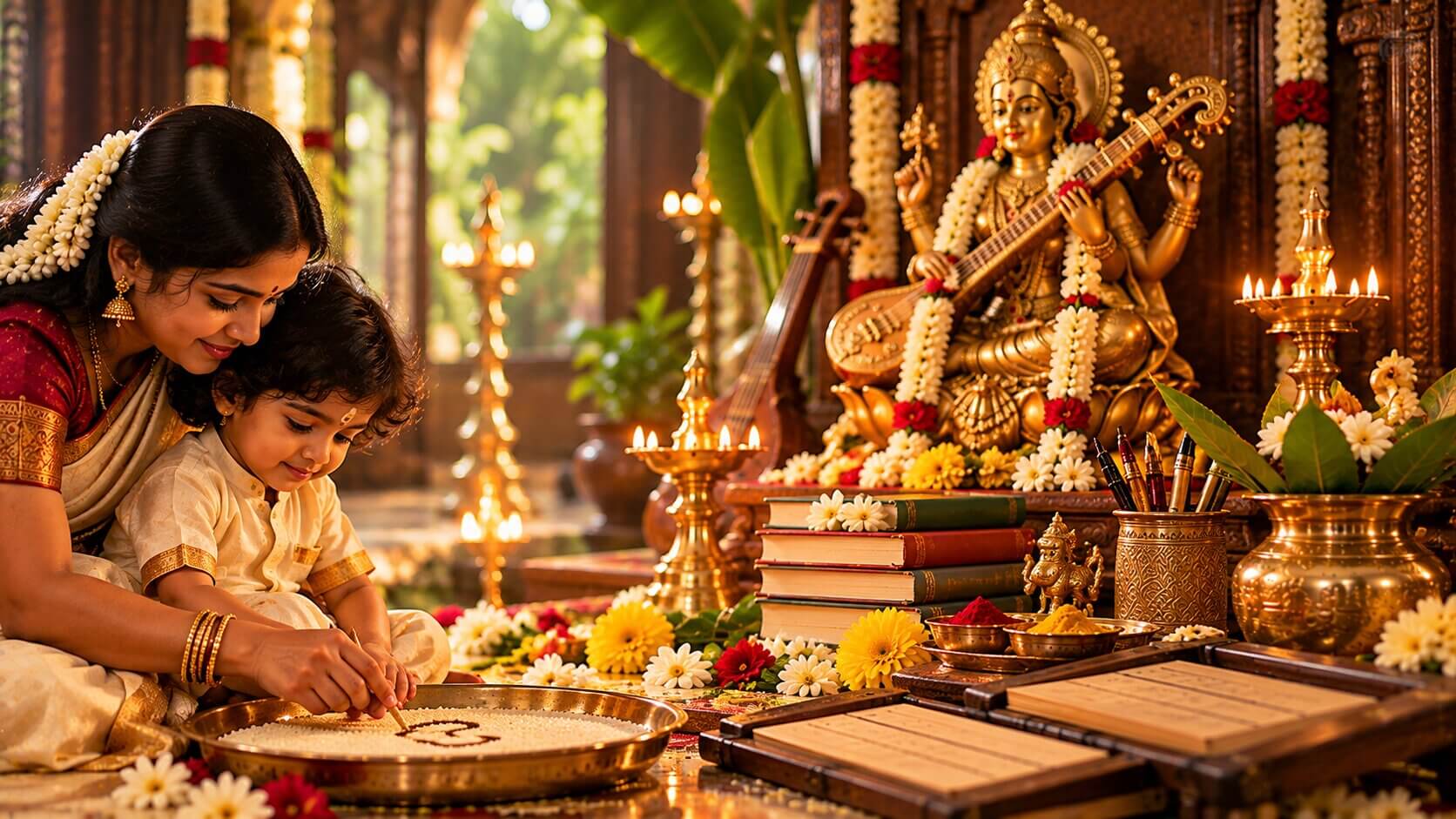
Vidyarambham literally points to the beginning of learning. In Kerala, Ezhuthiniruthu, the familiar initiation into letters, is strongly associated with Vijayadashami. It is often conducted at temples and cultural institutions, such as the Panachikkadu Saraswathi Temple, as well as within families.
A teacher, elder or guru guides the child in writing the first letters, traditionally invoking Hari, Sri, Ganapati and Saraswati according to the institution or family custom. A child may be guided to form sacred or alphabetic letters in rice and then to write with guidance, depending on the tradition followed. The exact formula and medium (rice, sand or another surface-should) follow the tradition of the place conducting the ceremony.
The meaning is larger than handwriting practice: the child’s first formal step into learning is placed under Saraswati’s grace and the guidance of a teacher. Families should follow the exact wording and sequence used by their chosen temple, guru or community rather than copying a generic transliteration from a commercial blog.
What pooja items are actually useful?
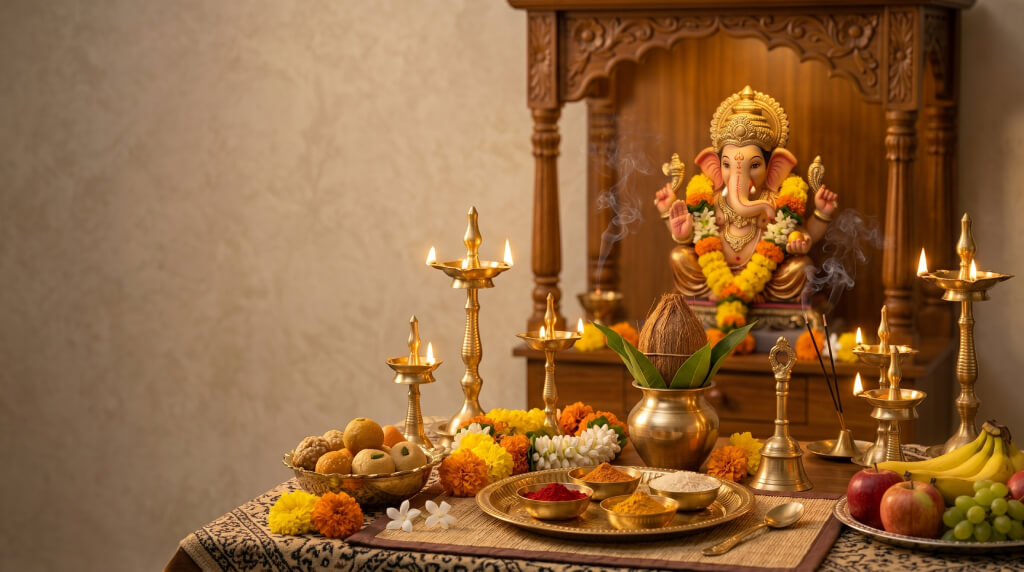
- A stable lamp or diya
- A pooja thali for flowers, kumkum/chandan and aarti items
- Fresh flowers
- Naivedyam
- A clean cloth or platform for books and instruments
- A bell, if used in your household worship
No special commercial “kit” is necessary if your home already has these basics.
A compact setup for homes without a separate pooja room
Use one clean table or shelf for the deity and lamp, and a separate stable surface immediately beside it for books or instruments. Heavy tools should remain on the floor or a safe work surface rather than being lifted onto a decorative altar. The visual goal is order and reverence, not a crowded display.
- Keep the lamp physically separate from books, paper and electronic equipment.
- Use a small pooja thali for kumkum, chandan, flowers and aarti items.
- Do not place food directly on books or instruments.
- Keep sharp tools sheathed or positioned safely.
- Photograph the arrangement only after safety and worship needs are settled.
Frequently Asked Questions
1. Are Saraswati Pooja and Ayudha Pooja the same?
They are closely connected in the Navaratri closing period but have different emphasis: Saraswati Pooja centres learning, arts and knowledge, while Ayudha Pooja honours tools and instruments of work.
2. When is Ayudha Pooja in Kerala in 2026?
Kerala’s official 2026 calendar lists Ayudha Pooja on 20 October, followed by Vijayadashami and Vidyarambham on 21 October.
3. Can laptops and work equipment be included?
Many modern households include the tools genuinely used for study or work. Clean and arrange them safely rather than treating every electronic item as mandatory.
4. Should children study while books are kept for pooja?
Traditionally, no. In families that follow Pooja Veypu, the books are intentionally set aside and resumed after Pooja Eduppu on Vijayadashami.
5. Do I need a new pooja thali for the festival?
No. A clean existing thali is sufficient. A new brass thali is a practical long-term purchase only if your household needs one.
Anugrah Aura practical note
Keep the diya physically separate from paper and equipment, and use a compact thali to contain powders, flowers and aarti items. Heavy or sharp work tools should stay on a stable lower surface rather than being moved onto an altar for appearance.
References and Sources
Editorial note: Festival dates vary by regional panchang and local tradition. Readers are advised to confirm observance dates and auspicious timings with their local temple or panchang.