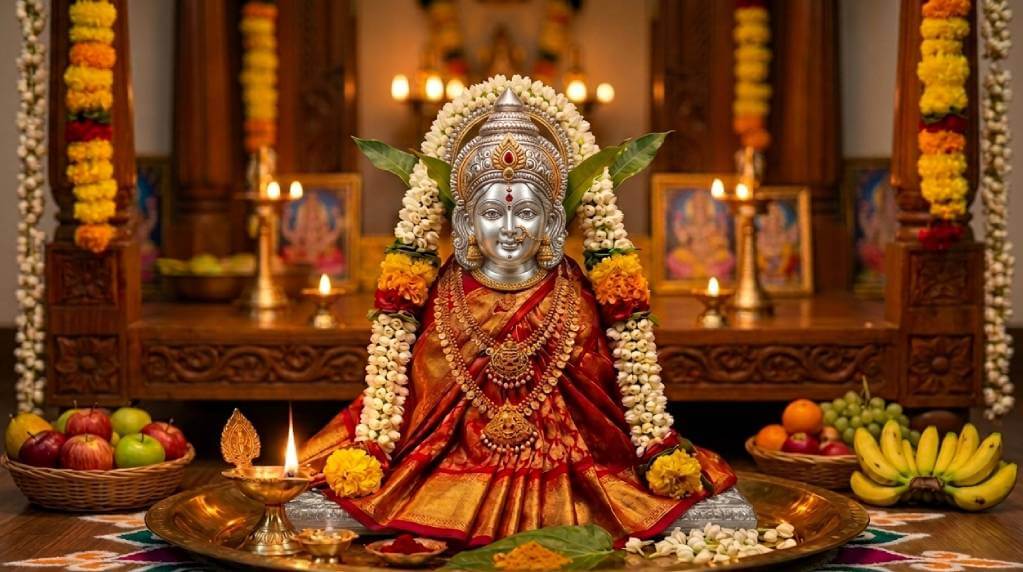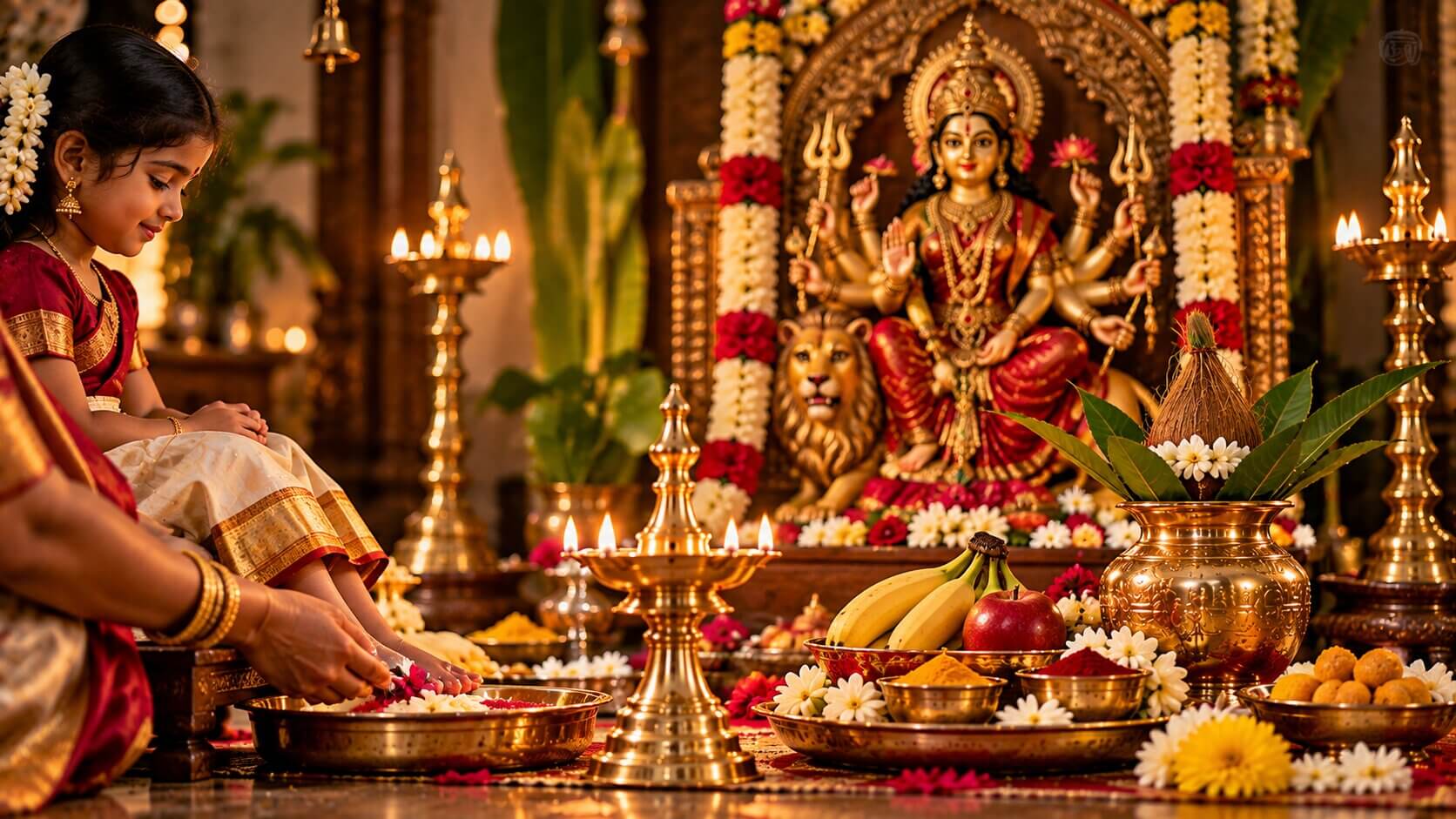



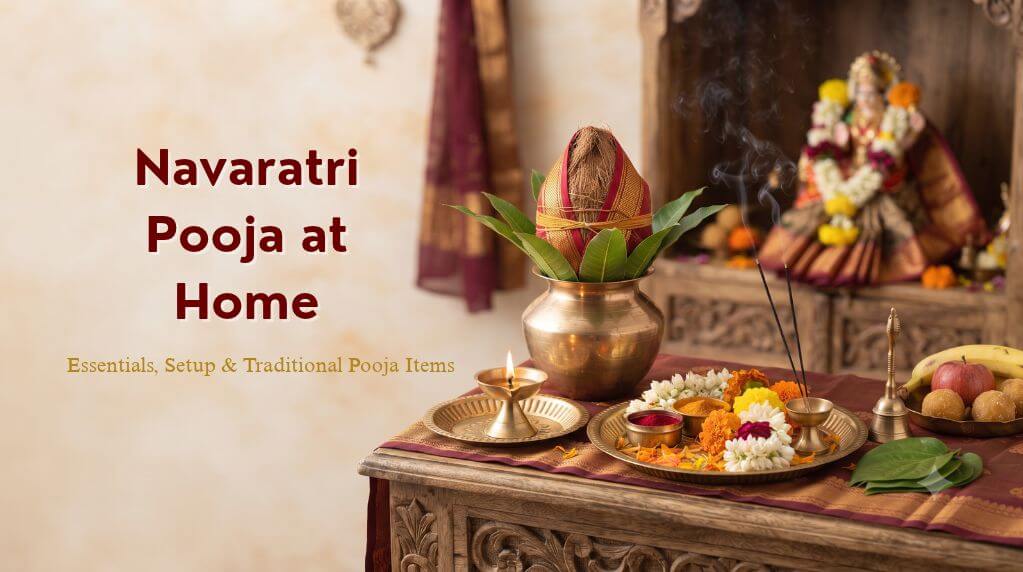
Navaratri pooja at home can be simple. The setup may include a clean pooja space, a Devi image or idol, diya, kumkum, turmeric, flowers, coconut and other traditional offerings. A kalash, bell and pooja thali may also be included depending on the family’s regional and household tradition.
The items you need therefore depend on how your family observes Navaratri. A simple Devi pooja does not require an elaborate arrangement.
Navaratri Pooja Items List
Here is a practical checklist for a home Navaratri setup:
| Item | Purpose |
|---|---|
| Devi Durga or other Devi image/idol | Main form of worship |
| Kalash or lota | Used in some pooja traditions |
| Coconut | Traditionally used with the kalash in many practices |
| Mango leaves | Commonly arranged around the kalash |
| Diya | For lighting during the pooja |
| Kumkum | Used in Devi worship and offerings |
| Turmeric | Traditional pooja offering |
| Flowers | Offered to Devi |
| Incense | Used during prayer |
| Camphor | Used for aarti according to family practice |
| Brass bell | Used during pooja and aarti |
| Pooja thali | Keeps the main pooja items together |
| Naivedyam | Food, fruit or other offering |
Not every family uses every item. Regional customs, temple traditions and family practices can change the arrangement.
1. Kalash and Coconut
A kalash is one of the familiar elements in many Navaratri pooja arrangements.
For a traditional kalash setup, families may use:
- Brass kalash or lota
- Water
- Mango leaves
- Coconut
- Turmeric and kumkum
- Rice or other items according to family tradition
The exact preparation varies between traditions, so there is no single method that every household follows.
A brass kalash/ lota can be reused for Navaratri as well as other pooja occasions throughout the year.
2. Diya for Navaratri Pooja
A diya brings light into the pooja space and is traditionally lit during worship.
Depending on the household tradition, you may use:
- A simple brass diya
- A Lakshmi diya
- A multi-wick diya
- An Akhand Jyothi setup where that practice is followed
An Akhand Jyothi is associated with traditions in which a lamp is kept continuously lit during the festival. It should not be presented as a requirement for every Navaratri pooja.
For a simple home Devi pooja, one clean brass diya is enough if that is what your family normally uses.
3. Kumkum and Turmeric
Kumkum and turmeric are traditional items in many Hindu pooja practices and are especially familiar in Devi worship.
Keep them in clean pooja containers so that the altar remains organised.
When women are invited for pooja or thamboolam, kumkum may also be offered to guests according to family custom.
4. Flowers for Devi Pooja
Flowers are commonly offered to the Goddess during Navaratri.
You can use fresh flowers available locally rather than treating one particular flower as compulsory. The choice may depend on the Goddess being worshipped, local tradition and availability.
A flower basket can be useful for keeping flowers together before and during the pooja.
5. Brass Bell
A plain brass pooja bell is suitable for a general Devi pooja.
The bell can be used during worship and aarti according to family practice. A simple design also makes it useful for other poojas throughout the year.
6. Pooja Thali
A pooja thali keeps the smaller essentials together and makes the setup easier to manage.
A basic thali can hold items such as:
- Kumkum
- Turmeric
- Flowers
- Akshata or rice
- Diya
- Incense
- Camphor
- Small containers for offerings
Anugrah Aura stocks 6-inch and 8-inch brass pooja thali sets, which can be reused for Navaratri and other pooja occasions.
How to Set Up a Simple Navaratri Pooja at Home
You do not need a large altar for Navaratri.
A simple arrangement can follow this order:
1. Clean the pooja space
Clean the area and place a fresh cloth or suitable base.
2. Place the Devi image or idol
Keep the chosen form of Devi in the central position.
3. Arrange the kalash
If your family tradition includes kalash worship, prepare it using the customary method. Mango leaves and coconut are commonly used in kalash arrangements.
4. Keep the diya nearby
Place the diya safely where it will not come into contact with flowers, cloth or other combustible material.
5. Arrange the pooja thali
Keep kumkum, turmeric, flowers and other small offerings together.
6. Keep the bell within reach
The bell can remain beside the pooja space for use during worship and aarti.
7. Prepare the naivedyam
Offer fruit, homemade food or another naivedyam according to your family’s practice.
The purpose is not to make the altar elaborate. A clean, orderly space with the items used in your family’s worship is enough.
South Indian Navaratri Pooja Setup
Navaratri is observed in different ways across South India. Tamil Nadu and Kerala share several practices, including Devi worship, Saraswati Pooja, Ayudha Pooja and Vijayadashami observances, but the customs and terminology can vary between regions, communities and families.
Two particularly relevant South Indian traditions are Golu in Tamil Nadu and the Saraswati Pooja and learning-related observances associated with Kerala.
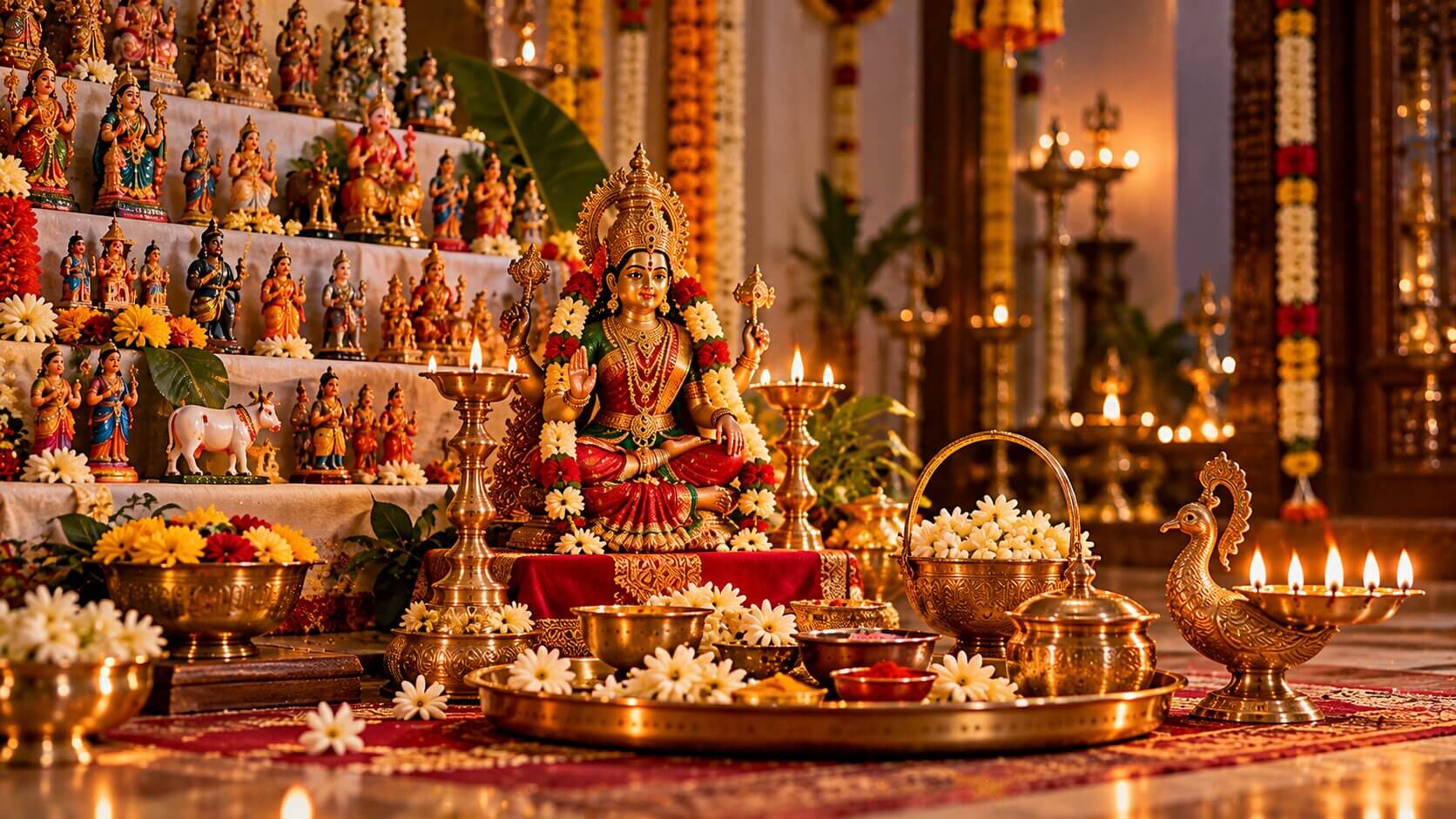
Golu or Bommai Golu Setup
In Tamil households that observe Golu or Bommai Golu, dolls and figurines are arranged on steps during Navaratri.
A home Golu setup may include:
- Golu steps
- Traditional dolls and figurines
- A small Devi or other deity arrangement
- Lamps
- Flowers
- Kumkum
- Offerings
- Thamboolam for visiting women
- Small return gifts for guests
The Golu arrangement becomes part of both the devotional and social aspects of Navaratri.
Golu is also observed by some communities in Kerala, so it should not be treated as a tradition found only in Tamil Nadu.
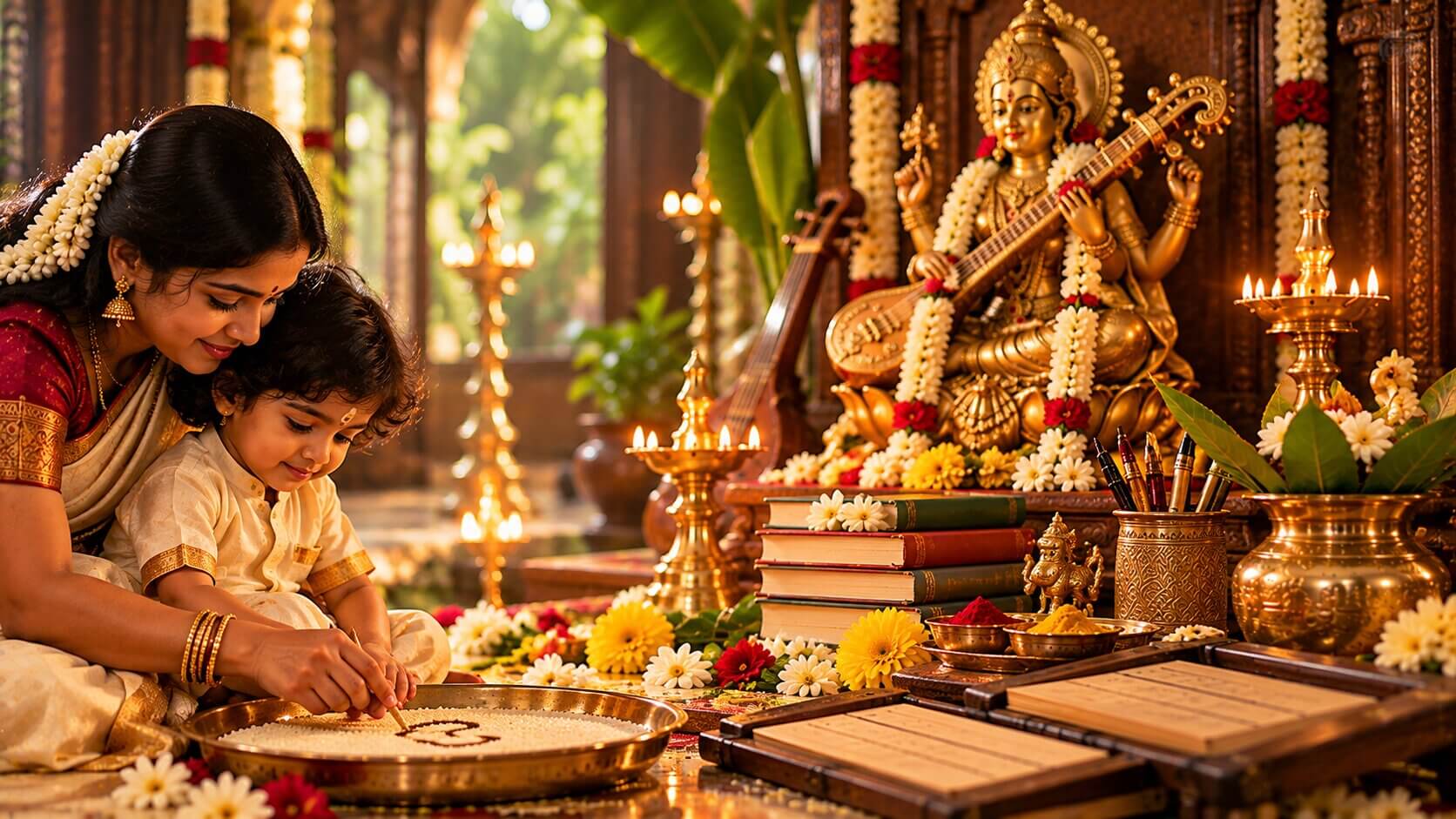
Saraswati Pooja, Grantham Vayppu & Ayudha Pooja
Saraswati Pooja and the worship of learning materials are observed in both Kerala and Tamil Nadu, although the terminology and exact customs can differ.
A home setup may include:
- Books and notebooks
- Musical instruments
- Art or learning materials
- Tools, instruments or work-related objects for Ayudha Pooja
- Saraswati image or idol
- Flowers
- Diya
- Kumkum
- Offerings
In Kerala, placing books and learning materials for worship is commonly associated with Grantham Vayppu, as part of the wider Poojavaipu observance. Worship continues through Mahanavami, with Ayudha Pooja also observed for tools, instruments and other work-related objects.
On Vijayadashami, the worshipped books and objects are taken out during Pooja Eduppu, followed by Vidyarambham according to the family’s or temple’s tradition.
In South India, Saraswati Pooja and Ayudha Pooja are also important Navaratri observances. Books, musical instruments, tools, vehicles and other work-related objects may be included in the worship according to local and family customs.
Navaratri 2026 dates
For 2026, Navaratri begins on 11 October and Vijayadashami falls on 20 October. Poojavaipu and Grantham Vayppu fall on or around Durgashtami evening, 18–19 October, depending on the tithi and local observance. Check the local panchang for the exact time before performing Poojavaipu.
What About Ghatasthapana, Akhand Jyoti and Kanya Puja?
These practices are important in several Navaratri traditions, but they should not be presented as compulsory for every Indian household.
Ghatasthapana
Ghatasthapana involves establishing a sacred kalash at the beginning of Navaratri and is particularly associated with traditions in North and Western India.
The precise Ghatasthapana muhurat depends on the local panchang, so households following this practice should check the appropriate local timing.
Akhand Jyoti
Some households maintain a continuously burning lamp during Navaratri. This is a specific devotional practice rather than a universal requirement.
Kanya Puja
Kanya Puja, in which young girls are worshipped and offered food or gifts, is followed in several North Indian traditions. Its observance varies by region and family.
For a general home Navaratri pooja, these practices are best understood as regional or family-specific additions, rather than items that everyone must purchase.
Navaratri Pooja Items for Different Home Setups
| Home setup | Useful essentials |
|---|---|
| Simple Devi pooja | Devi image/idol, diya, kumkum, turmeric, flowers, incense, bell |
| Kalash-based setup | Kalash, coconut, mango leaves, diya, kumkum, flowers |
| Golu home | Golu steps, dolls, lamps, flowers, kumkum, pooja items, thamboolam |
| Saraswati Pooja | Books, instruments or learning materials, Saraswati image, diya, flowers, kumkum |
| Larger family pooja | Pooja thali, kalash, diyas, flowers, naivedyam and additional offerings |
Brass Items That Work Well for Navaratri Pooja
Brass is practical for pooja items because many pieces can be cleaned and reused for different festivals and daily worship.
For a Navaratri home setup, useful brass pieces include:
- Brass kalash lota for the pooja arrangement
- Brass diya for daily lighting
- Brass pooja thali for organising offerings
- Plain brass bell for worship and aarti
- Brass flower basket for keeping flowers
- Lakshmi or Devi-related brass diyas and idols where they suit the family’s worship tradition
The idea is to choose pieces that will remain useful after Navaratri rather than buying something only for one festival.
A Simple Navaratri Pooja Checklist
Before starting the pooja, check that you have:
☐ Devi image or idol
☐ Kalash, if followed in your tradition
☐ Coconut
☐ Mango leaves
☐ Diya and oil/ghee
☐ Kumkum
☐ Turmeric
☐ Flowers
☐ Incense
☐ Camphor, if used
☐ Brass bell
☐ Pooja thali
☐ Rice/akshata
☐ Naivedyam
☐ Drinking water and other offerings as required by your family tradition
You do not need to buy everything on this list. Use the items customary in your household and add anything specific to the way you observe Navaratri.
Frequently Asked Questions
What are the essential items for Navaratri pooja at home?
The basic items can include a Devi image or idol, diya, kumkum, turmeric, flowers, incense and suitable offerings. A kalash, coconut, bell and pooja thali can be added according to regional and family traditions.
Is a kalash necessary for Navaratri pooja?
Not for every form of Navaratri worship. Kalash installation is an important part of some traditions, while other households follow a simpler Devi pooja.
Which leaves are used for a Navaratri kalash?
Mango leaves are commonly used in kalash arrangements. The exact preparation and number of leaves can vary by tradition.
Can I do Navaratri pooja with a simple diya?
Yes. A simple diya can be part of a home Navaratri pooja. Whether a household maintains an Akhand Jyothi or uses a particular number of lamps depends on its tradition.
What is needed for Saraswati Pooja during Navaratri?
Families following Saraswati Pooja may place books, musical instruments or other learning materials for worship, along with the usual pooja items. In Kerala, this tradition is particularly associated with the final days of Navaratri.
What is the difference between a North Indian and South Indian Navaratri setup?
There is no single North Indian or South Indian setup. Practices vary considerably. Ghatasthapana, fasting and Kanya Puja are prominent in some North and Western Indian traditions, while Golu in Tamil communities and Saraswati Pooja, Poojavaipu and Vidyarambham in Kerala represent important South Indian traditions.
Navaratri Pooja at Home: Keep It Traditional, Keep It Personal
Navaratri does not need to become a complicated shopping list.
Start with the form of worship followed by your family. Keep the pooja space clean, arrange the essential items with care and add regional traditions that make the festival meaningful.
Whether the setup is a simple Devi pooja, a Golu display or a Kerala-style Saraswati Pooja, the essentials are the same at heart: a sacred space, sincere worship and the traditions your family follows.